
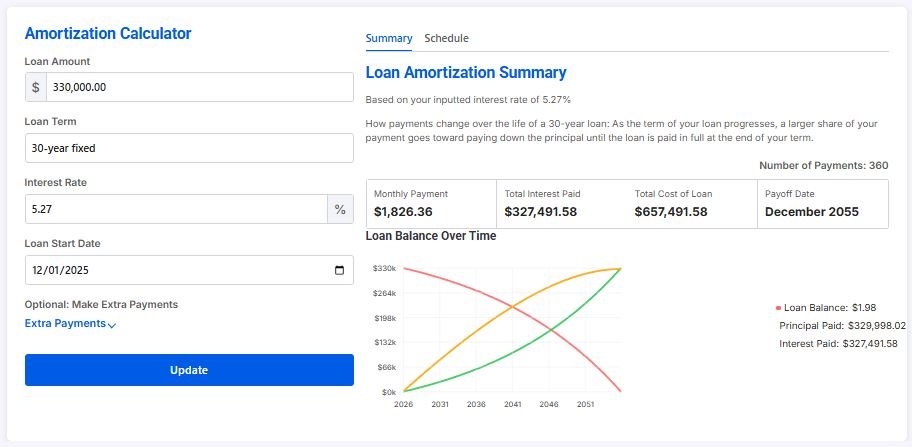
I’ll never forget the day I saw my first amortization schedule.
I had a car loan, and I was making my payments on time every month. I felt so responsible. I figured my $400 payment was split pretty evenly—a little bit of a fee to the bank, and the rest paying down the car. It seemed logical.
Then a friend who was an accountant showed me the “secret map” of my loan. It was a grid of numbers called an amortization schedule, and it showed exactly where every single dollar of every single payment would go for the next five years.
I felt like I’d been duped.
For the first year, almost my entire $400 payment was going straight to the bank as “interest.” I had barely made a dent in paying off the car. I was essentially just renting money, and the car wasn’t getting paid off at all.
This is the power of amortization. The banks live and breathe this concept. It’s how their entire business model works. And they are quietly hoping you never figure it out. Because once you do, you learn how to beat the game.
What is Amortization? (The No-Nonsense Version)
Let’s cut through the jargon.
Amortization is just the payment schedule that shows how a loan dies.
It’s a month-by-month breakdown of how your payment is split into two buckets:
- The Interest Bucket: The bank’s profit.
- The Principal Bucket: The actual money you borrowed.
The secret that changes everything is that this split is wildly uneven, especially at the beginning of your loan. It’s a trick called front-loading.
The Front-Loading Trick: How the Game is Rigged
Every standard loan—mortgages, auto loans, personal loans—is front-loaded with interest.
This means in the early years, the vast majority of your payment is dumped into the interest bucket. Only a tiny fraction goes toward your principal. As time goes on, the split slowly shifts. In the final years of the loan, your payment is finally mostly principal.
Let’s look at a 30-year mortgage for $400,000 at 6%. The monthly principal & interest payment is about $2,398.
- Your very first payment: Of that
2,398,amassive∗∗2,398,amassive∗∗2,000** is pure interest. Only $398 actually goes to paying off your house. - After 10 years: You’ve paid the bank over $287,000. But you’ve only paid off about $65,000 of your principal. The other $222,000 was just interest.
The bank gets their money first. That’s the system.
- Your Next Step: Don’t just take my word for it. See it for yourself. Go to an Amortization Calculator. Plug in your own mortgage or car loan numbers. It will generate your personal “secret map.” Seeing how little principal you’re paying at the beginning is a powerful, eye-opening moment.
How to Use This Secret to Your Advantage
Okay, so the system is tilted in the bank’s favor. But understanding amortization gives you the power to tilt it back.
Because interest is calculated on your remaining principal balance, every extra dollar you pay directly to the principal saves you from all the future interest that dollar would have generated.
It’s a cheat code. Making an extra principal payment is like time travel—you are literally wiping out future interest payments from existence.
Let’s go back to that $400,000 mortgage. What if you made just one extra payment per year, or found a way to pay a little extra each month?
- Your Next Step: This isn’t a fantasy; it’s just math. Use a Mortgage Payoff Calculator. This incredible tool will show you exactly how much faster you can pay off your loan and, more importantly, how much money you can save. Playing with the “extra payment” field will show you that even an extra $100 a month can shave years off your loan and save you tens of thousands of dollars in interest.
Amortization isn’t just a boring word. It’s the rulebook for the most expensive game most of us will ever play. The bank has read the book. It’s time you did, too. Once you understand the map, you can finally find the shortcuts.

