
I remember the first time a doctor told me my BMI. I was in my early twenties, sitting on a crinkly paper-covered exam table, and the doctor looked at my chart and said, “Okay, so your BMI is 26.1, which puts you in the ‘overweight’ category.”
The word hung in the air. Overweight.
I was a pretty active guy. I played basketball with my friends, I went to the gym a couple of times a week. I felt… fine. But this one number, calculated by a formula I didn’t understand, had just slapped a negative label on me. It felt unfair and, honestly, a little embarrassing.
For years, I was haunted by that number. I thought of it as a grade for my health, and I was failing.
It took me a long time to understand the truth: Body Mass Index (BMI) is not a perfect science. It’s not a judgment. It’s a tool. And like any tool, it can be useful, but it can also be misused. It’s a starting point for a conversation, not the final verdict on your health.
If you’ve ever felt confused or judged by your BMI, let’s pull back the curtain and talk about what this number really is, how it’s calculated, and—most importantly—what it doesn’t tell you.
What is BMI, Anyway? (And How is it Calculated?)
Let’s get the math out of the way first. It’s surprisingly simple.
Body Mass Index (BMI) is a measurement that uses your height and weight to estimate how much body fat you have. It was invented almost 200 years ago by a mathematician, not a doctor, as a quick way to look at weight trends in large populations.
The formula is: BMI = weight (kg) / height (m)²
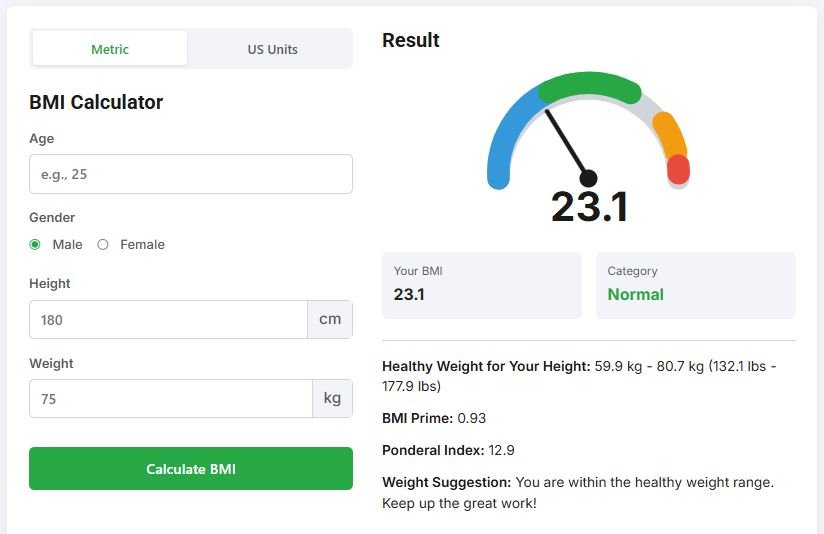
You don’t need to do that math yourself. That’s what a BMI Calculator is for. You just plug in your height and weight, and it spits out a number.
What Do the Numbers Mean? The Official Categories
Once you have your number, it gets sorted into one of these four main categories, as defined by the World Health Organization:
- Below 18.5: Underweight
- 18.5 – 24.9: Normal Weight
- 25.0 – 29.9: Overweight
- 30.0 and Above: Obesity
This is where the trouble starts. These words—”underweight,” “overweight,” “obese”—are loaded. They feel like judgments. But in the world of medicine, they are just clinical terms used to identify potential health risks.
The Big Problem with BMI: It’s a Blunt Instrument
Remember, BMI was designed to look at populations, not individuals. It’s like using a telescope to look at a single grain of sand. It can give you a general idea, but it misses all the important details.
Here’s what BMI completely ignores:
- Muscle vs. Fat: This is the big one. Muscle is much denser than fat. An athlete—a bodybuilder, a football player, a very fit person—can have a huge amount of muscle and very little body fat, but their high weight will give them a BMI in the “obese” category. They are obviously not obese.
- Body Composition: Where you carry your fat matters. Fat around your belly (visceral fat) is generally considered more of a health risk than fat on your hips and thighs. BMI has no idea where your fat is located.
- Age and Gender: A healthy body fat percentage is different for men and women, and it naturally changes as we age. BMI uses the same rigid categories for a 20-year-old man and a 65-year-old woman.
- Your Overall Health: BMI knows nothing about your blood pressure, your cholesterol, your blood sugar, how much you exercise, or what you eat. It’s a single data point in a huge, complex picture.
So, Is BMI Completely Useless?
No, not at all. It’s just misunderstood.
For the vast majority of people who are not elite athletes, BMI is a pretty good—and incredibly simple—indicator. It provides a quick snapshot that can be a useful starting point for a conversation with your doctor about your health.
If your BMI falls into the “overweight” or “obese” category, it doesn’t mean you are a bad person. It’s not a moral failing. It’s simply a signal. It’s an alert that says, “Hey, you might be at a higher risk for certain health issues down the road, and it’s something you should be aware of.”
That’s it. It’s a yellow light, not a red one.
The real power of BMI is using it as a tool for tracking change over time. If you’re on a health journey, seeing that number move from 29.1 to 27.5 to 25.9 can be incredibly motivating. It’s a simple way to measure progress.
The Bottom Line: BMI is a Data Point, Not a Definition
That day in the doctor’s office, I let a number define me. I was so focused on the “overweight” label that I missed the point. The doctor wasn’t shaming me; he was starting a conversation.
Your BMI is a piece of data. It is not your identity. It’s not a measure of your worth, your fitness, or your beauty. It’s just one, very basic tool in a huge toolbox for understanding your health. Use it as a starting point, talk to your doctor, and focus on the things that really matter: how you feel, how your body can move, and the healthy habits you build every day.

