
When we bought our first house, the bank sent us a welcome packet. Tucked inside was the amortization schedule for our 30-year mortgage. I looked at the final payment date, and a wave of exhaustion washed over me. I would be in my 60s. It felt less like a loan and more like a life sentence.
For years, I just accepted it. I made my payment on the first of every month, and that was that. I thought I was powerless, just a passenger on a 360-payment journey.
Then I discovered a “secret weapon.” A simple, almost laughably easy trick that the banks know all about but rarely advertise. It’s the power of making extra principal payments. It’s not just about paying a little more; it’s about a targeted, strategic attack that can fundamentally change the timeline of your loan.
It’s the key to getting out of debt years, or even decades, sooner.
How It Works: The Magic of Skipping Future Interest
To understand why this works, you need to understand a dirty little secret about how your loan is structured. It’s a concept called front-loading.
In the early years of your mortgage, your monthly payment is almost all interest. Only a tiny sliver goes toward paying down your actual loan balance (the principal). It’s a system designed to make sure the bank gets their profit first.
- Want to see the proof? Go to an Amortization Calculator and plug in your own loan details. You will be shocked to see how little of your payment is actually going toward your house in these early years.
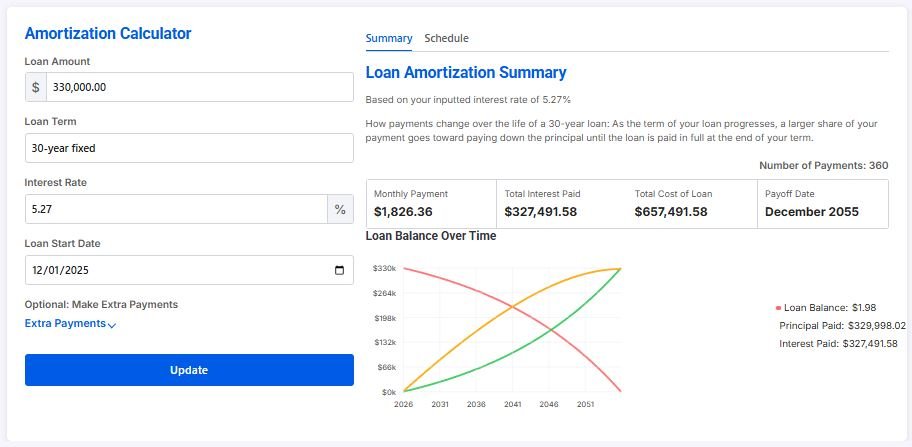
Here’s where the magic happens. The amount of interest you’re charged each month is calculated based on your current principal balance. So, when you make an extra payment and tell the bank to apply it “directly to the principal,” you are doing something profound.
You are shrinking the balance that they can charge interest on, forever.
That single extra payment doesn’t just pay off the loan a little faster. It creates a ripple effect. It eliminates all the future interest that would have been charged on that piece of the principal for the rest of the loan’s life. You are literally wiping future bills out of existence.
Let’s See the Math: The “Wow” Moment
This isn’t just a theory. Let’s look at a real example.
Say you have a
350,000,30−yearmortgage∗∗ata∗∗6350,000,30−yearmortgage∗∗ata∗∗62,098.
- Scenario 1: You do nothing extra. You will pay a staggering $405,450 in interest over 30 years.
Now, let’s see what happens when you apply this secret weapon.
- Scenario 2: You round up your payment. You decide to pay an even $2,200 every month. That’s an extra $102.
- You will pay off your mortgage 4 years and 7 months early.
- You will save $76,700 in interest.
- Scenario 3: You use the “bi-weekly” trick. You split your monthly payment in half and pay it every two weeks. This results in one extra full payment per year.
- You will pay off your mortgage almost 5 years early.
- You will save over $81,000 in interest.
- Scenario 4: You get aggressive. You get a raise and decide to put an extra $300 per month toward the principal.
- You will pay off your mortgage 9 years and 2 months early.
- You will save a life-changing $144,500 in interest.
This isn’t a fantasy. It’s just math.
- Your Next Step: Stop wondering and start planning. The most powerful tool at your disposal is a Mortgage Payoff Calculator. This is your personal “what-if” machine. Plug in your own loan numbers and play with the “extra payment” field. See for yourself how an extra $50, $100, or $200 a month can change your life.
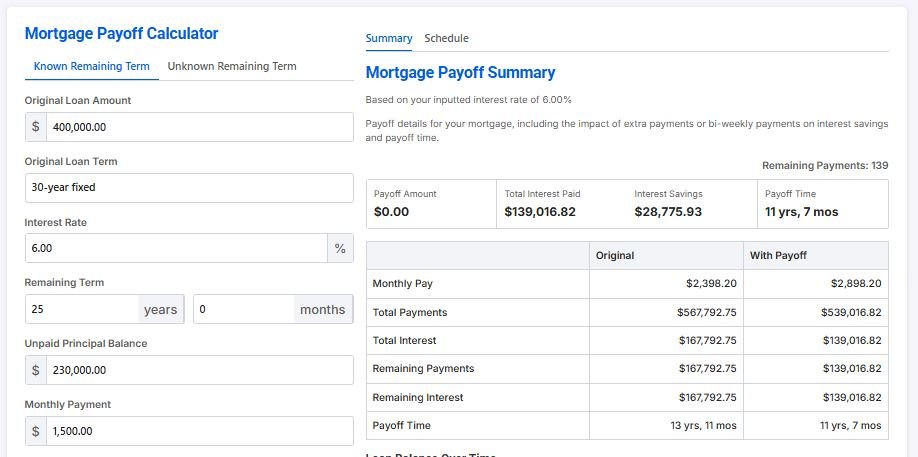
How to Do It Right
This is critical. When you send extra money, you must specify that it should be applied “to principal only.” If you don’t, some lenders will just apply it to your next month’s payment, which does you no good. Most online payment portals now have a specific box you can check for extra principal payments.
This strategy isn’t just for mortgages. It works for car loans, too. A good Auto Loan Calculator will also show you an amortization schedule and the effect of extra payments.
You are not stuck with your 30-year sentence. You are in control. Every extra dollar you send is a vote for your own freedom, a way to buy back your most valuable asset: your time.

